


Structures
 Home
>>
Structures
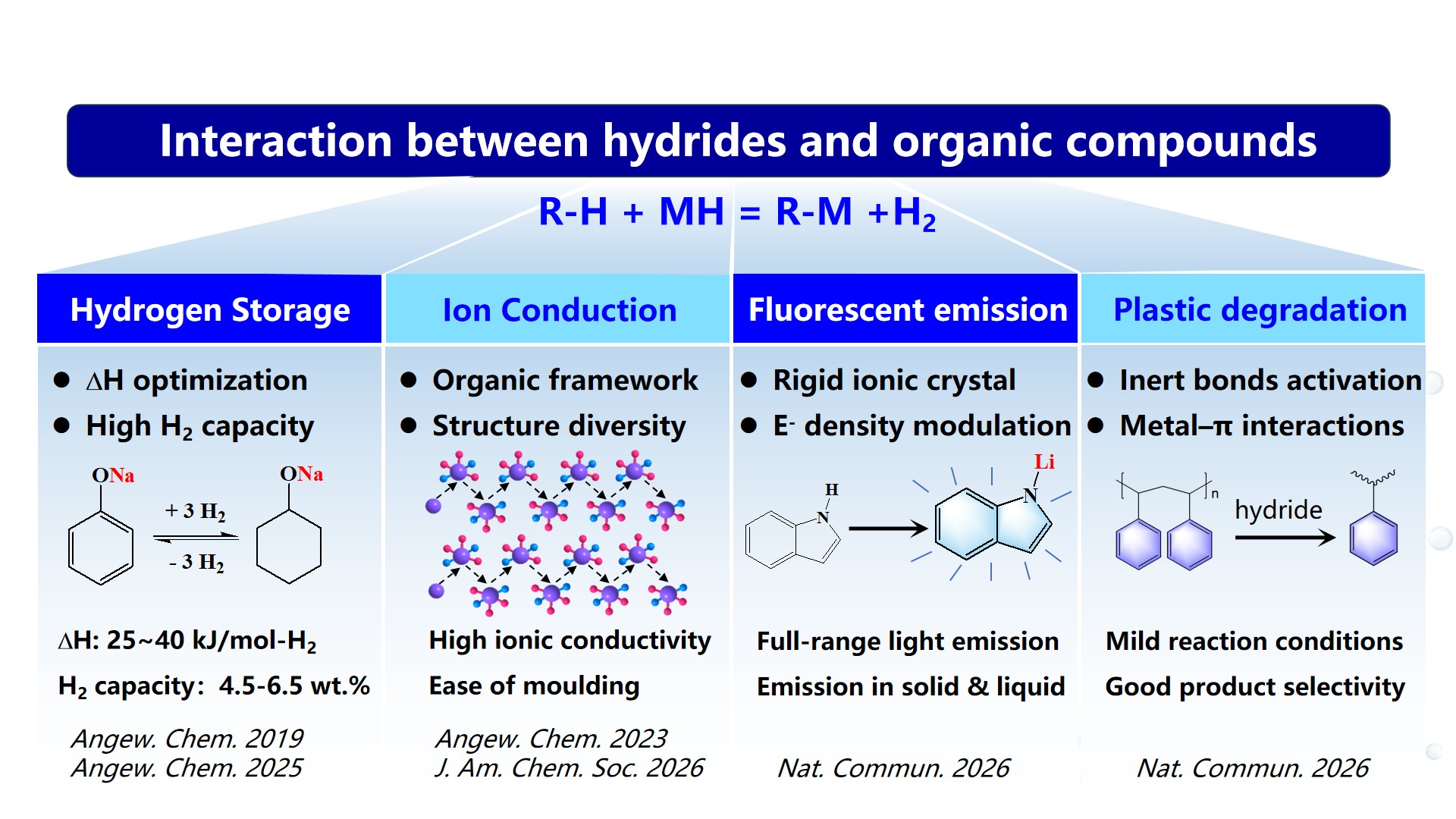
The implementation of a hydrogen-based energy economy remains constrained by the lack of effective solid-state storage media with favorable thermodynamic release profiles. Despite inorganic hydrides have been extensively investigated, organic compounds, characterized by their structural diversity and intrinsic capacity for C–H bond functionalization, have received little attention due to unfavorable dehydrogenation enthalpies (ΔHd) and poor reaction selectivity under operating conditions. To overcome these fundamental barriers, we introduced a metal-substitution approach, wherein the protic H in O–H, N–H, S–H, or Al–H of organic molecules was replaced with alkali or alkaline earth metals, yielding a new family of hydrogen storage materials, namely Metalorganic Compounds (MOCs) that span across the domains of inorganic and organic hydrides. Critically, this approach enables precise modulation of the dehydrogenation thermodynamics, achieving ΔHd in the ideal range of 30-40 kJ/mol-H2, which facilitates reversible hydrogen storage under mild operating conditions, while concurrently maintaining gravimetric capacities >6.0 wt.%. These metrics render MOCs viable candidates for practical, low-temperature hydrogen storage systems (Angew. Chem. Int. Ed., 2019; Energy Storage Mater., 2020; J. Energy Chem., 2025; Angew. Chem. Int. Ed., 2025). Beyond hydrogen storage, the unique structural characteristics of MOCs have motivated further investigations of these materials in diverse potential applications, including ion conduction (Angew. Chem. Int. Ed., 2023; Adv. Funct. Mater., 2024; J. Am. Chem. Soc., 2026) and luminescent materials (Nat. Commun., 2026).
Other than the reaction between protic H and hydrides, we are also interested in the degradation of plastics, typically polymers. Conventional transition-metal-catalyzed hydrogenolysis, however, suffers from harsh conditions (elevated temperatures and high H2 pressures), over-hydrogenationm coking, poor C–C bond selectivity, and competitive H2/polymer adsorption on the metal surface. These limitations arise because hydride species in such systems are generated in-situ via heterolytic H2 dissociation, which demands high temperatures and in vulnerable to competitive adsorption. In contrast. hydrides inherently contain strongly reducing H- centers that can directly attack electrophilic Hδ⁺ sites along the polymer backbone, activating inert C–H bonds by deprotonation without prior H2 activation. Exploiting this strong reducing capacility, we propose that many polymers waste can be converted into valuable lower aromatics under milder conditions, where hydride-induced deprotonation activates the otherwise inert polymer chain and facilitates subsequent C–C bond cleavage (Nat. Commun., 2026).
Papers
• Angew Chem. Int. Ed., 2019, 58, 3102.
• Angew Chem. Int. Ed., 2023, 62, e202302679.
• Angew. Chem. Int. Ed. 2025, 64, e202506275.
• J. Am. Chem. Soc. 2026, 148(15), 15576-15585.
• Nat. Commun. 2026, 17, 6148.
• Nat. Commun. 2026, https://doi.org/10.1038/s41467-026-78624-4.
• Appl. Catal. B-Environ., 2023, 336, 122947.
• Appl. Catal. B-Environ., 2017, 211, 167-175.
• Energy & Environmental Science, 2012, 5, 5686-5689.
• Advanced Functional Materials, 2024, 2412005.
• Energy Storage Materials, 2020, 26, 198-202.
• ACS Materials Letters, 2021, 3, 1417-1425.
Reviews and perspectives
• Acc. Mater. Res. 2021, 2, 726.
• Nat. Rev. Mater., 2016, 1, 16059-16075.
• Adv. Mater., 2019, 31, 1902757.
• Trends in Chemistry, 2022, 4, 935-947.

Dalian Institute of Chemical Physics (DICP), Chinese Academy of Sciences No. 568 Lvshun Middle Road, Dalian, Liaoning, China 116023.

+86-411-39787225

116023
xiedong@dicp.ac.cn
©Center for Hydride Energy Chemistry

Wechat official account