Recently, the research team led by Professor Ping Chen and Professor Teng He from the Hydrogen Energy and Advanced Materials Division, Center for Hydride Energy Chemistry (DNL1901) at Dalian Institute of Chemical Physics, Chinese Academy of Sciences, has successfully developed a new class of high‑performance solid‑state fluorescent materials: Alkali Metal N-heteroarene salts based on an alkali metal substitution strategy.
In earlier work, the team successfully synthesized a series of metalorganic compounds (MOCs) using a metal substitution strategy, gaining substantial experience in hydrogen storage and ionic conduction. To date, the research team developed a series of MOC‑based hydrogen storage systems (Angew. Chem. Int. Ed., 2019;Energy Storage Mater., 2020; J. Energy Chem., 2025; Angew. Chem. Int. Ed., 2025), overcoming the challenge of achieving both high hydrogen capacity and favorable dehydrogenation enthalpy. Furthermore, the research team also extended the application of MOC materials to solid‑state ionic conduction (Angew. Chem. Int. Ed., 2023; Adv. Funct. Mater., 2024; J.Am.Chem.Soc., 2026).
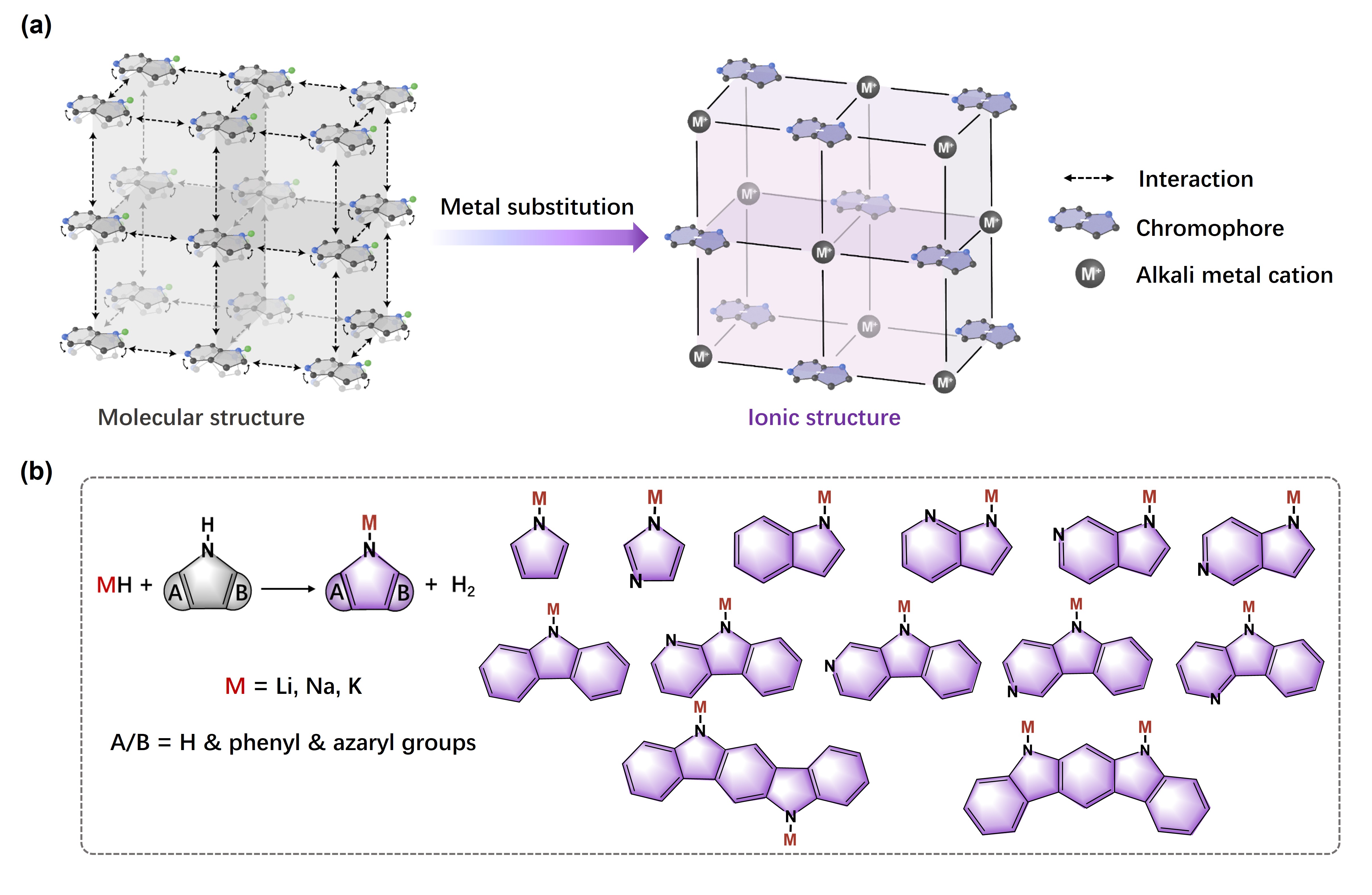
Meanwhile, organic luminescent materials have shown broad application prospects in lighting, displays, and bioimaging. However, conventional small organic molecules in the solid state often suffer from non‑radiative transitions induced by intramolecular vibrations and intermolecular interactions such as π–π stacking, leading to fluorescence quenching and low emission efficiency, especially for long‑wavelength emission. Therefore, simultaneously enhancing luminescence efficiency and tuning emission color has become a key challenge in the field. Building on this foundation, the team introduced the alkali metal substitution strategy into luminescent materials research. In the present work, the research team replaced the labile hydrogen atoms on the nitrogen atoms of N‑heteroarenes (e.g., imidazole, indole, carbazole) with alkali metals (Li, Na, K), successfully synthesizing over 30 new ionic fluorescent materials. Theoretical calculations and crystal structure analyses revealed the microscopic mechanisms underlying the enhanced luminescence and color modulation. On one hand, the alkali metal cations and N‑heteroarene anions form a rigid ionic lattice network through metal–nitrogen σ‑bonds and cation–π interactions, which substantially reduces the excited‑state structural reorganization energy, suppresses intramolecular vibrations and non‑radiative transitions, and thereby significantly improves luminescence efficiency. On the other hand, the introduction of alkali metals generates N‑heterocyclic anions, increasing the electron density of the conjugated system and modulating the bandgap of the materials, resulting in rich fluorescence emission across the visible spectrum. Furthermore, the team successfully demonstrated the potential application of these materials in information anti‑counterfeiting. This work provides a new strategy for the development of efficient and tunable small‑molecule‑based luminescent materials.
Article link: https://doi.org/10.1038/s41467-026-72600-8