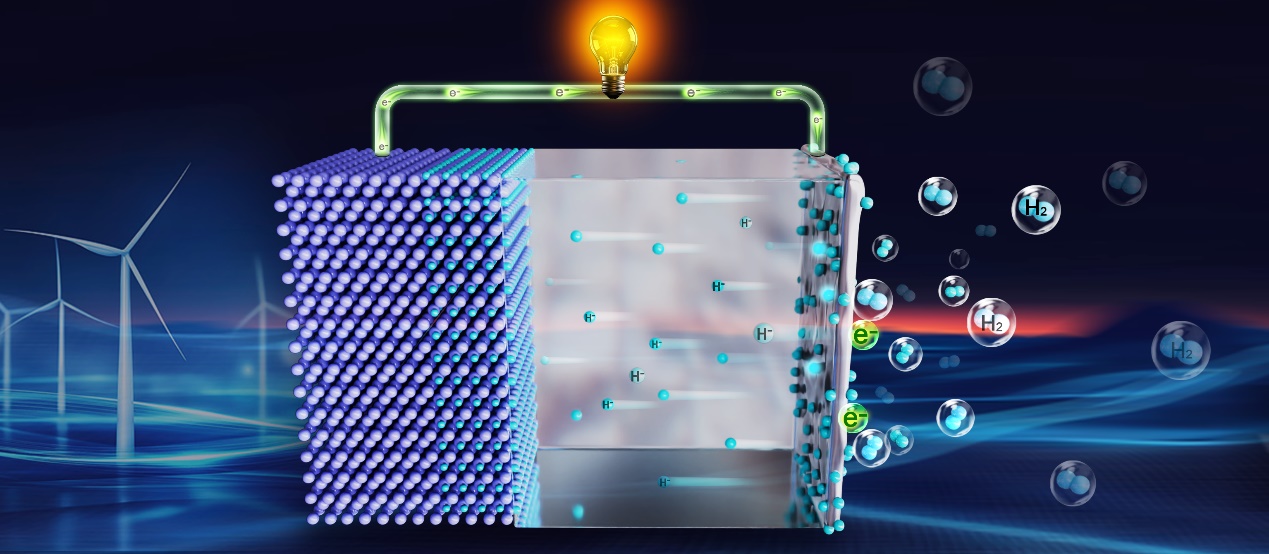
Efficient hydrogen storage remains one of the most critical challenges limiting the widespread adoption of hydrogen energy technologies. Conventional hydrogen storage methods typically rely on extreme conditions, such as high-pressure compression (up to 700 atm) or cryogenic liquefaction (−253 °C), resulting in high energy consumption, safety concerns, and increased system complexity. Developing a safe, efficient, and practical hydrogen storage technology under ambient conditions is therefore of great importance for the future hydrogen economy.
In a study published in Joule, a research team led by Prof. CHEN Ping’s from the Dalian Institute of Chemical Physics (DICP) of the Chinese Academy of Sciences (CAS) developed the world’s first gas-solid hydride ion prototype battery (g-HIB), which uses hydrogen gas and a metal as the electrodes. The battery not only powers electrical equipment, but also enables highly efficient hydrogen storage under ambient temperature and pressure through an innovative hydrogen-electricity co-storage mechanism.
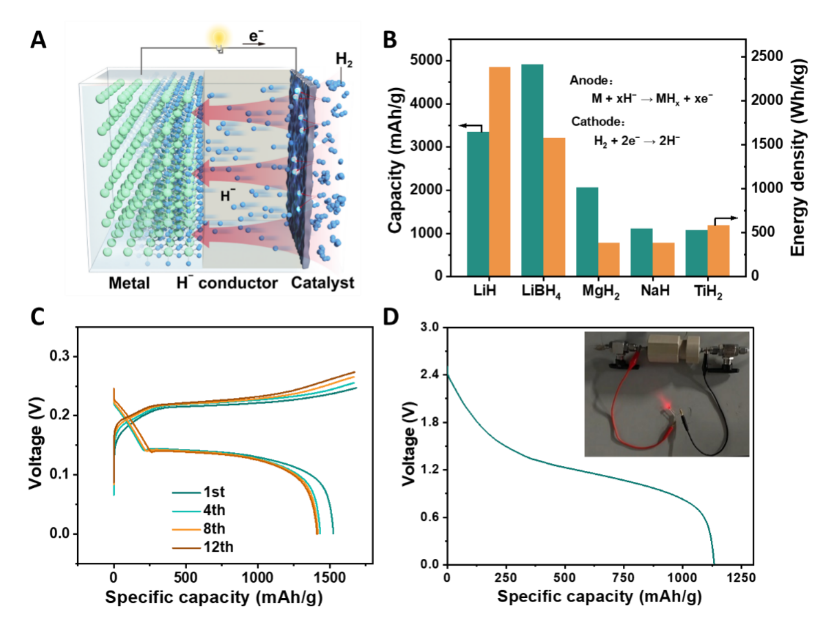
(A) Schematic diagram of the gas-solid hydride ion battery; (B) Theoretical specific capacities and energy densities of different hydrides; (C) Charge-discharge curves of the Mg-H2 gas-solid battery; (D) Discharge curve of serially connected Mg-H2 gas-solid batteries and driving a LED light. (Image by WANG Shangshang and Zhang Weijin)
Hydride ions (H⁻), the electron-rich form of hydrogen, possess high reactivity and energy density and are regarded as promising charge carriers for next-generation all-solid-state batteries. However, their intrinsic instability under ambient conditions has long hindered their practical application in electrochemical energy storage.
Since 2018, Prof. CHEN’s team has focused on hydride ion conduction research and developed a series of novel hydride ion electrolyte materials that enable stable hydride ion transport. In 2023 and 2025, the team reported the first low-temperature ultrafast hydride ion conductor and the first all-solid-state hydride ion prototype battery. Building on these advances, the researchers further proposed the concept of a gas-solid hydride ion battery.
In this work, the team assembled the first g-HIB using magnesium metal and hydrogen gas as the negative and positive electrode active materials, respectively. During discharge, hydrogen at the positive electrode is reduced to hydride ions, while magnesium at the negative electrode is oxidized and converted into magnesium hydride. The reverse process occurs during charging, enabling simultaneous hydrogen storage and electricity storage.
The battery exhibits a theoretical capacity higher than that of most known battery systems while integrating hydrogen storage functionality. Experimental results showed that, during hydrogen charging, the battery delivered an initial discharge capacity as high as 1526 mAh g⁻¹. Upon applying a voltage of 0.3 V, approximately 6.0 wt% hydrogen (based on MgH₂ in the electrode) could be released at room temperature. After 60 cycles, the capacity retention remained above 70%, and the battery operated stably across a wide temperature range from −20 to 90 °C.
Furthermore, a tandem stack consisting of ten single cells generated an output voltage exceeding 2.4 V and successfully powered an LED light, marking the birth of the gas-solid hydride ion prototype battery.
The researchers also demonstrated significant energy-efficiency advantages over conventional thermal hydrogen storage technologies. In traditional Mg/MgH₂ thermal storage systems, hydrogenation releases substantial heat that must be dissipated, while dehydrogenation requires temperatures of around 300 °C. By contrast, the g-HIB converts the heat released during hydrogenation directly into electrical energy and uses electrical energy to drive hydrogen release. As a result, the overall energy efficiency reaches 93.9%—approximately one-third higher than that of conventional thermal hydrogen storage systems.
This study establishes a new technological route for overcoming one of the most persistent bottlenecks in hydrogen energy storage. By eliminating the need for extreme pressure or cryogenic conditions, the technology could pave the way for next-generation hydrogen storage systems. For example, in hydrogen-powered drones, the g-HIB could serve as an efficient hydrogen supply module operating under ambient conditions while significantly extending flight endurance.
“Our future work will focus on developing higher-performance hydride ion conductors and electrode materials to further improve battery performance and accelerate the practical deployment of hydride ion battery technologies for hydrogen energy applications,” said Prof. CHEN.
Article link: https://doi.org/10.1016/j.joule.2026.102475