Ammonia synthesis is a cornerstone of modern agriculture and chemical industry, and also a promising carbon-free energy carrier for the future hydrogen economy. However, conventional transition metal-based ammonia synthesis catalysts are fundamentally limited by the linear scaling relationship (also known as the "BEP" relation), which results in a volcano-type activity curve. Early transition metals such as Mn bind N too strongly, making the hydrogenation of activated *N species extremely difficult. Consequently, highly efficient early transition metal-based ammonia synthesis catalysts have rarely been reported in the literature.
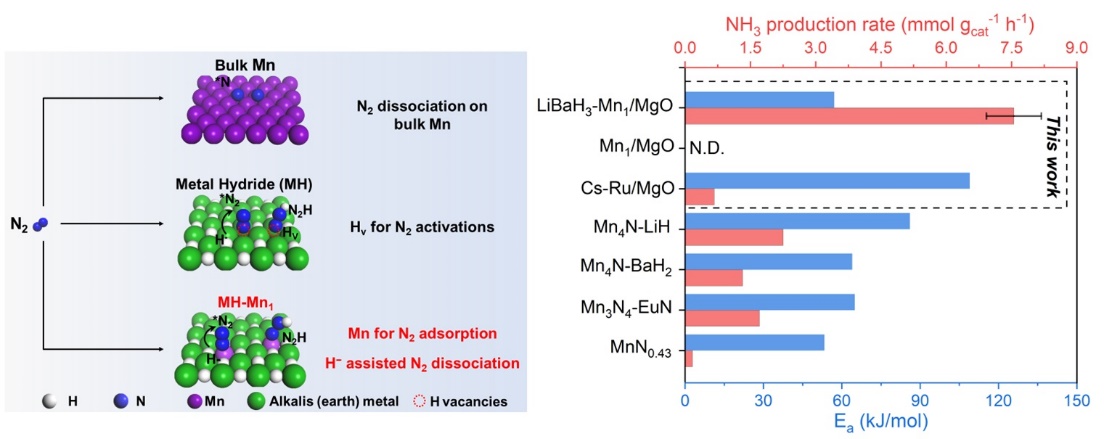
In a recent study published in Angewandte Chemie International Edition, a research team led by Prof. CHEN Ping from the Center for Hydrogen Energy Chemistry (DNL1901 Group) at the Dalian Institute of Chemical Physics (DICP) of the Chinese Academy of Sciences (CAS), in collaboration with Prof. YUAN Shaojun from Sichuan University, developed a highly efficient ammonia synthesis catalyst consisting of atomically dispersed early transition metal Mn supported on the ternary hydride LiBaH3. This catalyst achieves efficient ammonia synthesis through an H⁻-assisted N2 dissociation mechanism, which circumvent the scaling relationships.
In this work, the team prepared a LiBaH3-Mn1 catalyst, in which the activation of N2 on Mn1 sites, preventing the direct dissociation of N2 to form overly strong Mn-N bonds. While H− ions from LiBaH3 further activate the adsorbed *N2 through a reductive protonation process to form *N2H intermediates. Subsequent N–N bond cleavage of *N2H yields surface nitride (Mn–N) and imide (*NH) species on the LiBaH3–Mn1 surface. This catalyst exhibits an ammonia synthesis rate two orders of magnitude higher than that of manganese nitride and exceeds the benchmark Cs-Ru/MgO catalyst by a factor of 2.5 at 400 °C, representing a state-of-the-art performance among group 4–7 transition metal–based catalysts. This study provides a new strategy for the rational design of highly active early transition metal-based catalysts for ammonia synthesis.
Article link: https://onlinelibrary.wiley.com/doi/10.1002/anie.6169961




 Home
>>
Recent Posts
Home
>>
Recent Posts