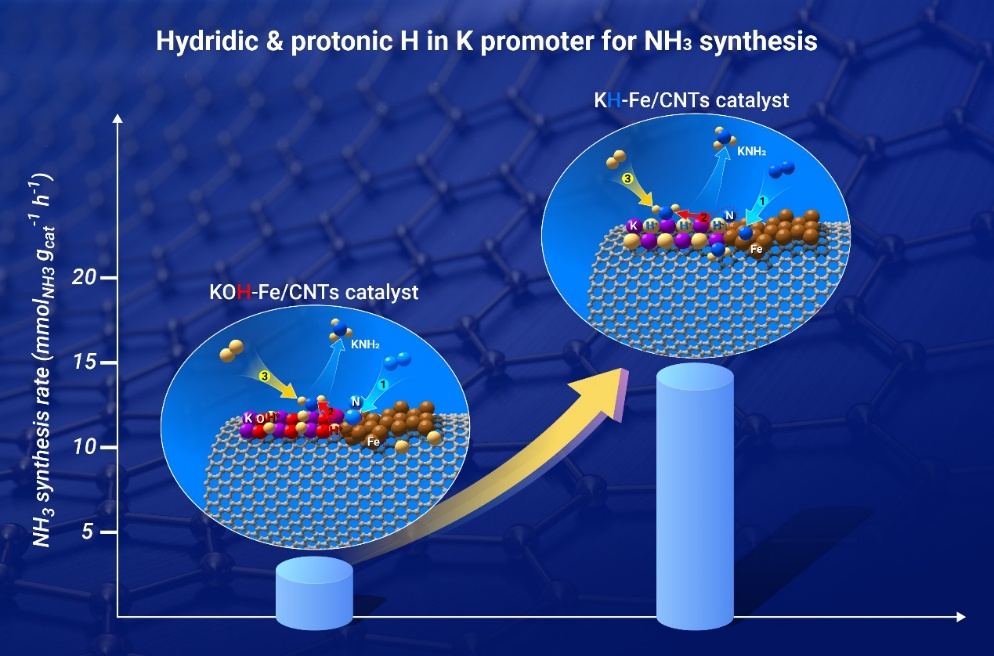
Potassium is one of the most widely used promoters in industrial iron-based ammonia synthesis catalysts. Although its beneficial effect on catalytic activity has been recognized for more than a century, the actual chemical state of potassium under reaction conditions and its promotional mechanism have remained subjects of long-standing debate. Conventional understanding generally attributes the promotional effect of potassium to its electron-donating ability, which facilitates N₂ dissociation on iron surfaces. However, key scientific questions—including the nature of potassium species under working conditions and the role of hydrogen species in nitrogen activation and ammonia formation—have not been fully clarified.
To address these issues, our research team systematically investigated the influence of different potassium chemical states on ammonia synthesis by comparing potassium hydride (KH) and potassium hydroxide (KOH) as promoters for carbon nanotube-supported iron catalysts (Fe/CNTs). By examining the catalytic process from the perspective of active hydrogen, we uncovered a previously unrecognized mechanism underlying potassium promotion. The study revealed that both KH and KOH significantly enhance the ammonia synthesis activity of iron catalysts, but through distinct pathways and with markedly different efficiencies. Under conditions of 300 °C and 1 MPa, the activity of the KH-promoted catalyst was nearly two orders of magnitude higher than that of pristine Fe/CNTs and approximately six times greater than that of the KOH-promoted catalyst. Correspondingly, the turnover frequency (TOF) of the KH system was about three times that of the KOH system.
Mechanistic investigations demonstrated that hydrogen species originating from both potassium promoters directly participate in ammonia formation. In the KH-promoted catalyst, hydridic hydrogen (H⁻) acts as a strong reducing agent and reacts with iron nitrides through a redox process, generating a KNH₂ intermediate while simultaneously regenerating active iron sites. Subsequent hydrogenation by gaseous H₂ efficiently produces NH₃. In contrast, in the KOH-promoted catalyst, protonic hydrogen (H⁺) participates in ammonia synthesis by protonating surface nitrogen species, proceeding through K–Fe–O and KNH₂ intermediate pathways. Isotope-labeling experiments provided direct evidence that lattice hydrogen from both KH and KOH preferentially contributes to the initial formation of ammonia. This finding challenges the traditional view that potassium functions solely as an electronic promoter and establishes active hydrogen as a key participant in the catalytic process.
This work identifies active hydrogen in potassium compounds as a critical contributor to ammonia synthesis catalysis, providing new experimental evidence for understanding the role of alkali-metal promoters in industrial ammonia synthesis catalysts. The findings not only reshape the fundamental understanding of potassium promotion but also open new avenues for the rational design of highly efficient ammonia synthesis catalysts operating under mild conditions.
Article link: https://doi.org/10.1016/j.xinn.2026.101435



 Home
>>
Recent Posts
Home
>>
Recent Posts