Recently, the National Natural Science Foundation of China (NSFC) website released the NSFC 2025 Annual Report. Our research work titled 'Room-Temperature All-Solid-State Hydride Ion Secondary Battery', was successfully selected for the NSFC 2025 Funded Achievements Tour, standing as one of the six representative achievements in the Department of Chemical Sciences.
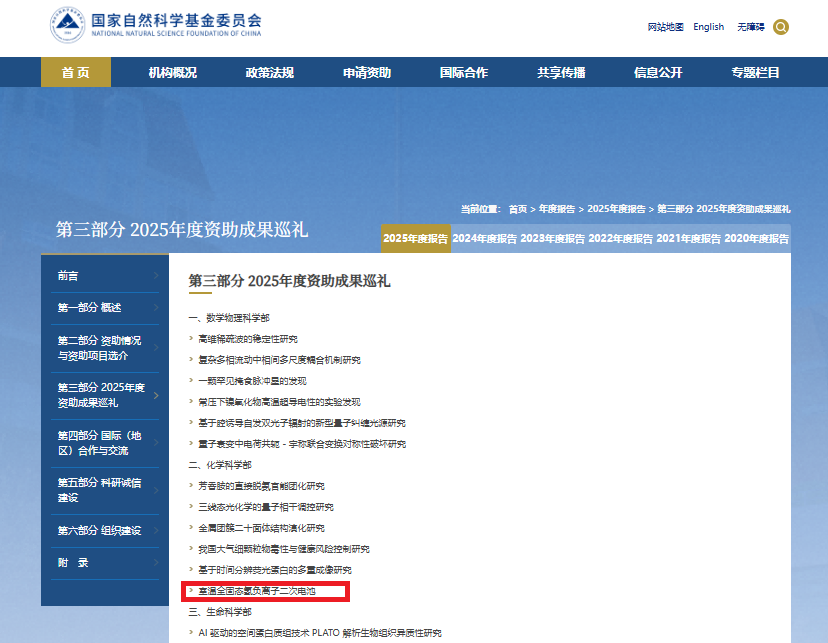
Image from NSFC official website
The hydride ion (H⁻), formed by the gain of one electron by a hydrogen atom, possesses characteristics such as light mass and a low redox potential (H2/H⁻, –2.3 V vs. standard hydrogen electrode). It is considered a new type of charge carrier in electrochemical devices, showing significant application potential in driving technological innovations in secondary batteries, fuel cells, electrolyzers, and more. However, due to the lack of electrolyte materials that simultaneously possess high ionic conductivity, low electronic conductivity, high thermal and electrochemical stability, and compatibility with electrodes, the technology of hydride ion secondary batteries has yet to achieve a breakthrough. Consequently, the development of hydride ion conductors with comprehensive performance has been regarded as a frontier topic in the fields of solid-state ionics and hydrogen energy.
With support from the NSFC (Youth Science Foundation Project (Category C) No. 22309175, General Program No. 22279130), the collaborative team of Professor Ping Chen, Professor Hujun Cao, and Dr. Weijin Zhang from the Dalian Institute of Chemical Physics, Chinese Academy of Sciences, made progress in the research of hydride ion conductors and hydride ion prototype batteries. The findings were published in Nature under the title 'A room temperature rechargeable all-solid-state hydride ion battery'.
Previously, the team utilized the characteristic of 'lattice distortion suppressing electronic conductivity' to develop a room-temperature superfast hydride ion conductor (related results were published in Nature in 2023). Building on this research, the team designed and prepared a novel core-shell structured composite hydride: 3CeH3@BaH2 by coating the less stable cerium trihydride with a thin layer of highly stable barium hydride that exhibits low electronic conduction. This material demonstrates fast hydride ion conduction at room temperature while also possessing excellent thermal and electrochemical stability. Using 3CeH3@BaH2 as the electrolyte, the classic hydrogen storage material sodium aluminum hydride as the cathode, and hydrogen-lean cerium dihydride as the anode, the team successfully constructed an all-solid-state hydride ion prototype battery. The battery delivered an initial discharge capacity of up to 984 mAh/g and retained a capacity of 402 mAh/g after 20 charge-discharge cycles. Furthermore, a stacked battery was built to increase the voltage to 1.9 V, successfully powering an LED (light-emitting diode), demonstrating the feasibility of using hydride ion batteries to supply power to electronic devices. This research marks a transition of the hydride ion battery from 'theoretical concept' to 'experimental validation'.
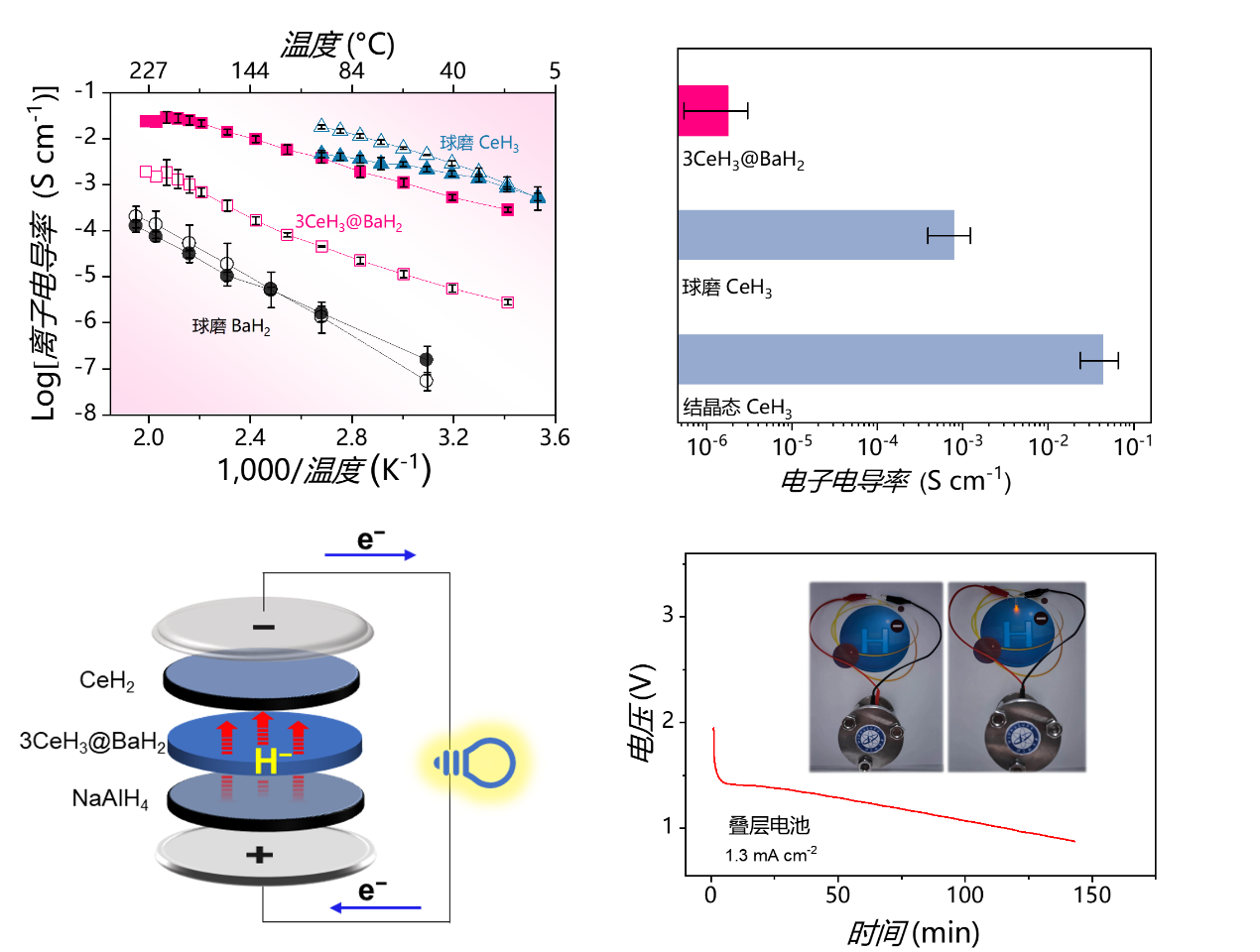
Core-Shell Structured Composite Hydride with Electrolyte 3CeH3@BaH2 and All-Solid-State Hydride Ion Prototype Battery
NSFC official link:室温全固态氢负离子二次电池
Research article link:https://www.nature.com/articles/s41586-025-09561-3



 Home
>>
Recent Posts
Home
>>
Recent Posts