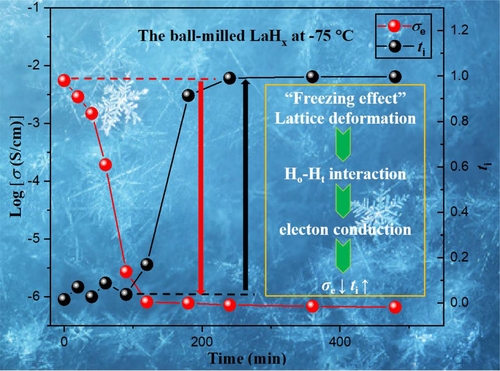
Recently, a team led by Professor Chen Ping and Professor Cao Hujun discovered a peculiar "freezing effect" in lattice-distorted lanthanum hydride, whereby temperature treatment can cause its electronic conductivity to irreversibly decrease by 2 to 3 orders of magnitude. They revealed that this mutation is related to changes in the coordination environment of tetrahedral hydrogen.
The high polarizability, high reducibility, and high redox potential of hydride ions give them important and unique advantages in the storage and conversion of hydrogen-related electrochemical energy. Hydride ion (H-) conductors are expected to bring a series of technological innovations in the fields of all-solid-state hydride batteries, fuel cells, electrochemical conversion cells, etc. Professor Chen's team previously developed a lattice distortion strategy to suppress the electronic conductivity of rare earth trihydrides (RE = La, Ce, Pr, Nd) (Nature, 2023; JEC, 2024), transforming the electron/hydride ion (H-) mixed conductor lanthanum trihydride into an ultrafast hydride ion conductor.
In this work, the team found that under low temperature conditions, the electronic conductivity of lattice-distorted lanthanum hydride showed a peculiar irreversible decrease. In contrast, the ionic conductivity did not change significantly, which caused the ion migration number of lattice-distorted lanthanum hydride to increase significantly from the initial 0.1 to above 0.99 and remain stable. However, the above changes did not occur in lanthanum hydride with good crystallinity. In situ Raman spectroscopic characterization found that in lattice-distorted lanthanum hydride materials, the vibration behavior of hydrogen in the octahedral position adjacent to the tetrahedron near its equilibrium position changed significantly when the temperature dropped to -40 °C, which means that the octahedral hydrogen may diffuse to defects such as grain boundaries and be "frozen", thereby establishing higher Schottky barriers at these defect sites to hinder the conduction of electrons. The team also found similar freezing effects in other lattice-distorted rare-earth hydrides. This work proves that lattice distortion influences the electron and ion conduction properties in hydrides, providing a basis for the research and development of new and efficient hydride ion (H-) conductors.
The results of this work were recently published in Angewandte Chemie International Edition under the title: "Abnormal Freezing Effect on Electron Conduction of Ball-milled Lanthanum Trihydride for Superionic Conductor". The first author of this work is Associate Professor Zhang Weijin from our group. The work was supported by the National Natural Science Foundation, Liaoning Binhai Laboratory Fund, Dalian Science and Technology Innovation Fund, and our Institute's Innovation Fund. (Text/Photo by Zhang Weijin).
Article link:https://doi.org/10.1002/anie.202417610