The activation and valorization of inert molecules, such as dinitrogen (N2), alkanes, and alkenes, for the synthesis of nitrogen-containing organic compounds have long been a highly sought-after goal in chemistry. However, it remains highly challenging due to the exceptional stability of the N≡N and C-H bonds, as well as the difficulty in achieving their cooperative activation under mild conditions.
Recently, a research group led by Prof. CHEN Ping and Prof. GUO Jianping from the Dalian Institute of Chemical Physics (DICP) of the Chinese of Academy Sciences (CAS), developed a heterogeneous strategy for the direct synthesis of aniline from dinitrogen and benzene, mediated by magnesium oxide supported sodium hydride (NaH/MgO). This study was published in Nature Communications.
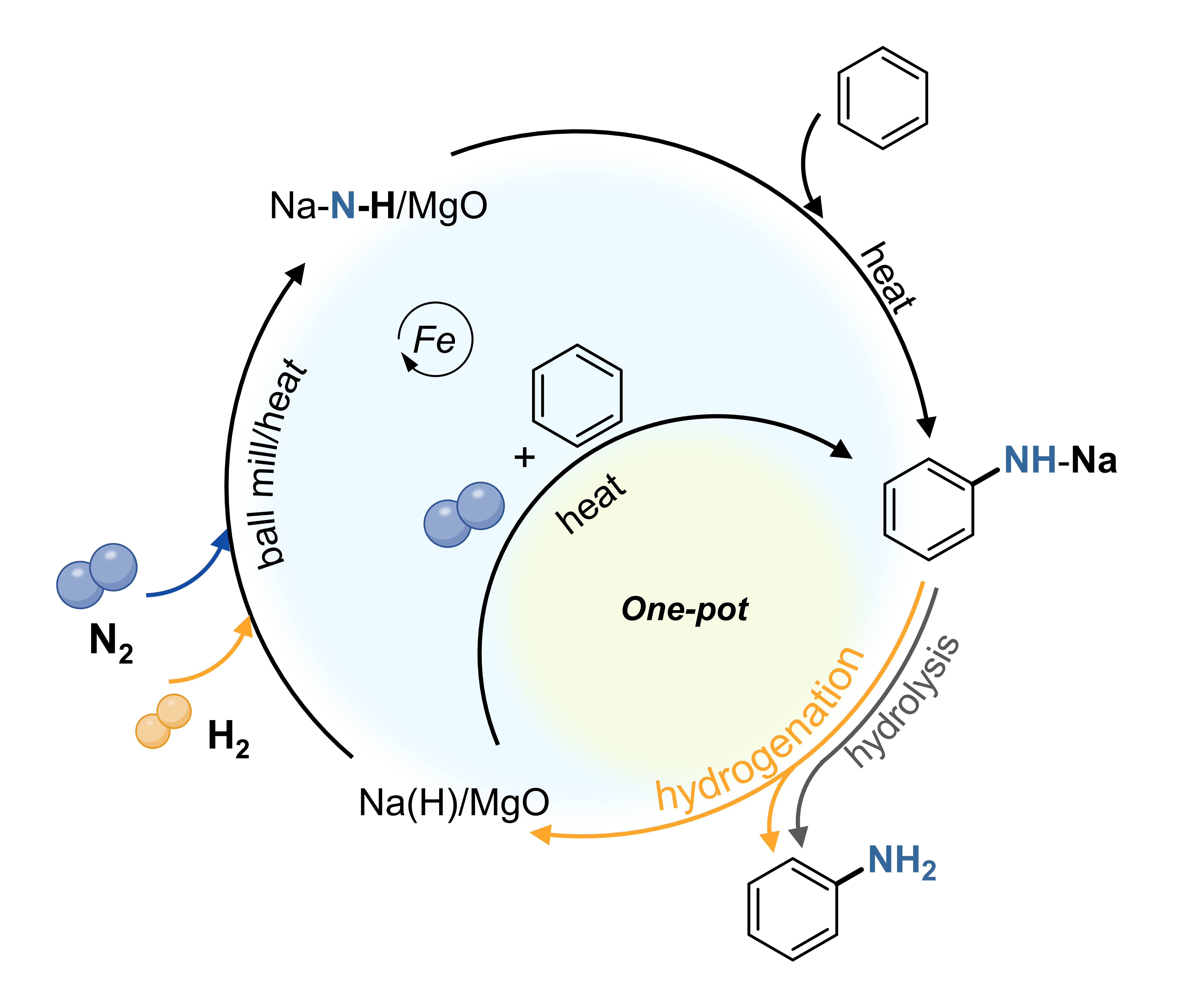
Scheme of Aniline synthesis from N2 and benzene mediated by NaH/MgO.
In this work, aniline can be synthesized via a stepwise process. First, N2 fixation was achieved by ball milling Na and MgO under N2/H2 atmosphere, affording an intermediate containing reactive NHx species (Na-N-H/MgO). The intermediate subsequently reacted with benzene upon heating to construct C-N bond, forming sodium anilide. Hydrolysis or protonation yielded the target product aniline with high selectivity. In this process, the introduction of transition metal Fe further improved the reaction efficiency. In addition, one-pot of C-N bond construction can be achieved in the NaH/MgO system by co-feeding dinitrogen and benzene, which significantly simplified the reaction procedure.
Experimental and theoretical studies revealed that interfacial hydride species formed from NaH on the MgO support play a key role in the reaction. These species enable the stepwise reduction of dinitrogen followed by aromatic C-H bond activation, thereby facilitating the cooperative transformation of N≡N and C-H bonds.
“This work opens up new opportunities for the advancement of heterogeneous materials aimed at converting N2 and hydrocarbon sources into value-added nitrogen-containing organic compounds.” said Prof. GUO.
Article link: https://www.nature.com/articles/s41467-026-71592-9




 Home
>>
Recent Posts
Home
>>
Recent Posts